
Scripture Readings: Exodus 20:1-4, 7-9 & Matthew 21:33-46
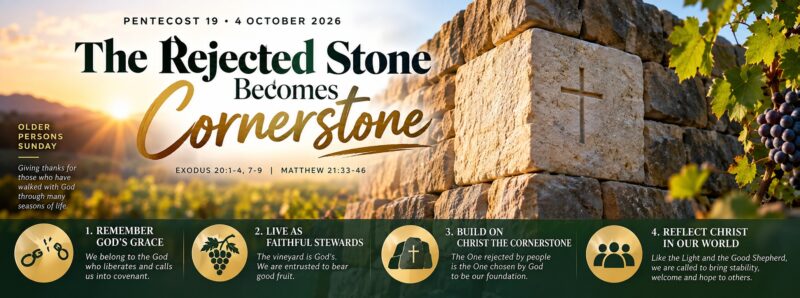
On this Older Persons Sunday, we give thanks for those who have walked with God through many seasons of life, whose faith, wisdom, prayers, love, and faithful service have helped to build and sustain our community. Their lives remind us that faith is not only something we confess with our lips; it is something we live, nurture, and pass on through the years.
Exodus 20 reminds us that we belong first to the God who liberates us and calls us into covenant faithfulness, while Jesus’ parable in Matthew 21 reminds us that the vineyard is God’s, not ours. We are stewards, entrusted with what belongs to God and called to bear good fruit.
(Slide 1) Exodus 20 begins not with a command but with God’s identity and saving action: “I am the LORD your God, who brought you out of Egypt, out of the house of slavery.” Covenant comes before command; grace before obligation; liberation before law. God’s people are called to live faithfully because God has already rescued them and claimed them as God’s own.
(Slide 2) The commandments, therefore, are more than restrictions. They describe the shape of a liberated life. God has brought Israel out of Pharaoh’s slavery; now they must learn not to become enslaved again to idols, false gods, misuse of God’s name, or self-centred desires. The commandments become a grammar of freedom, worship, relationship, trust, and holy living.
So, we might ask: What has become “ultimate” in our lives? What controls our choices, fears, time, and energy? Idols are not only carved images. Success, money, power, security, control, reputation, or even our own opinions can become ultimate when they take the place that belongs to God.
(Slide 3) To misuse God’s name is to separate God’s name from God’s character. For those who publicly identify themselves with God, this raises a searching question: Does the way we live honour the name we carry? And Sabbath is more than simply taking a day off. Sabbath is an act of trust. God remains God even when we are not working. The Sabbath is a day to love and worship God with all our heart, mind, and strength.
In Matthew 21, Jesus tells a parable about a landowner who carefully prepares a vineyard. He plants it, builds a wall around it, digs a winepress, and constructs a watchtower. Before the tenants have done anything, much has already been given to them.
The vineyard begins with gift and trust. But gradually the tenants behave as though the vineyard belongs to them. They reject the servants, mistreat them, and finally kill the landowner’s son. Their deepest failure is not simply poor management. They have forgotten the difference between stewardship and ownership.
Our lives, gifts, time, church, ministries, relationships, resources, creation, and opportunities are all entrusted to our care. The parable asks what happens when stewardship becomes possession and gratitude becomes entitlement.
There is also something deeply moving in the landowner’s persistence. He sends servant after servant. Finally, he sends his son. In Matthew’s Gospel, this points us toward Jesus and anticipates his rejection and death.
(Slide 4) Yet rejection is not the final word. Jesus recalls Psalm 118: “The stone that the builders rejected has become the cornerstone.” Human rejection cannot defeat God’s purpose. The rejected stone becomes the cornerstone.
A cornerstone is not simply another stone in a building. It establishes the direction and alignment of the whole structure. If the cornerstone is wrongly placed, everything built upon it is affected. Jesus reveals a profound reversal: the One rejected by people becomes the One chosen by God to be the foundation and defining centre of God’s work.
(Slide 5) This is why “The Church’s One Foundation” speaks so powerfully today. The Church does not rest on our strength, traditions, or years of service; its foundation is Jesus Christ. Generations change and ministries change, but Christ remains. Those who have walked faithfully with God for many years remind us that while we serve, build, and plant, the Church ultimately belongs to Christ.
The tenants forgot that the vineyard was not theirs. We, too, can easily build our lives as though we were the owners, setting our own direction and then asking Christ merely to fit into what we have already constructed.
(Slide 6) But Jesus is not an additional stone to be fitted conveniently into our plans. He is the Cornerstone by whom everything else must be aligned – our worship, priorities, relationships, ministries, and the fruit we bear. So, the question is not simply, “Is Christ somewhere in the building of our lives?” but also, “Is my life continually being built and realigned around Christ?”
Everything begins with what God has already given: freedom to Israel, a vineyard to the tenants, grace to us. The question is not whether we have received God’s gifts, but what kind of life those gifts are producing in us. If God has given us freedom, covenant, grace, Christ, and a place in God’s vineyard, what fruit is God finding in our lives today?
(Slide 7) Jesus alone is the true Cornerstone, just as he is the Light of the world and the Good Shepherd. Yet the Light calls us to let his light shine through us. The Good Shepherd calls us to follow Him and care for those entrusted to us. And the Cornerstone calls us to build our lives upon Him and help others find strength, belonging, and hope in Him.
We do not replace the Cornerstone; we reflect the One upon whom our lives are built. So, wherever God has placed us, may we become people who bring stability rather than division, encouragement rather than discouragement, welcome rather than rejection, and love rather than indifference.
Perhaps this is particularly meaningful on Older Persons Sunday. Those who have travelled many years with God have a precious ministry, not simply because of what they have accomplished, but because of the faith they continue to embody, the wisdom they share, the prayers they offer, the stories they carry, and the encouragement they give to generations following behind them.
And this calling belongs to every generation. With Christ dwelling in our hearts, may we become “cornerstone people”: people others can trust, people who help hold a community together, people who welcome those who feel rejected or forgotten, and people through whom the steadfast love of Christ can be seen.
Christ is the Cornerstone. We are not called to replace Him, but to reflect Him in a fractured world to steady, connect, welcome, encourage, and help others find their place in God’s household.
Whether young or old, may we build our lives upon Christ the Cornerstone, remember that the vineyard belongs to God, live as grateful stewards of all we have received, and bear the good fruit of God’s kingdom. And may our lives always point beyond ourselves to Jesus Christ.
Thanks be to God! Amen.
(Ref. Bible, commentaries, theological books, UCA materials, and a Vanderbilt Divinity Library Resources)Top of Form