
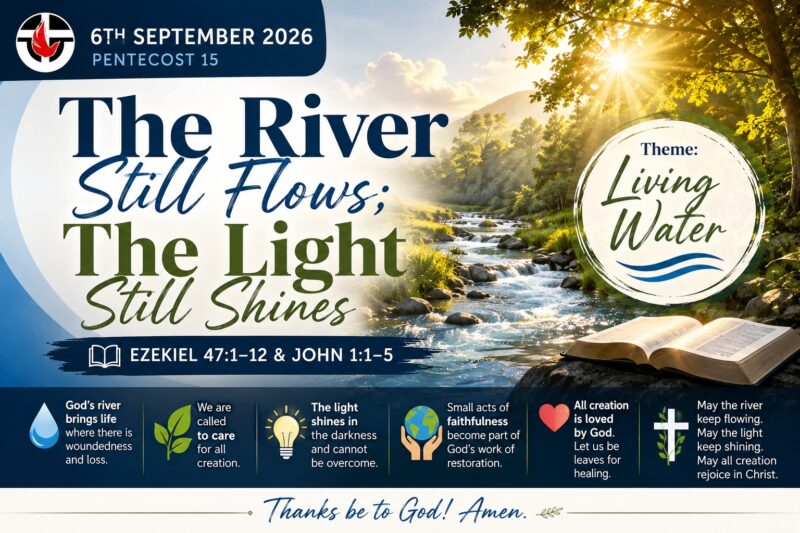
Scripture Readings: Ezekiel 47:1–12 & John 1:1–5
(Slide 1) In Ezekiel 47:1–12, Ezekiel sees water, but this water is unlike any ordinary river. “Wherever the river goes, every living creature that swarms will live” (v.9). Ezekiel receives this vision in a time of exile, loss, and brokenness. God’s people have lost their homeland, their temple, their security, and much of what once seemed permanent.
(Slide 2) Yet into that landscape of loss, God gives Ezekiel a vision of hope. Water flows from the temple. At first, it is only a small stream, but it becomes ankle-deep, then knee-deep, then waist-deep, until finally it becomes a river too deep to cross. Ezekiel does not simply watch the river from a distance; he is led into it.
And wherever the river flows, life returns. Dead places begin to live. The waters are healed. Fish become abundant. Trees grow on both sides of the river. Ezekiel tells us, “Their leaves will not wither nor their fruit fail.” They bear fruit because the water comes from the sanctuary. Then comes one of the most beautiful lines in the vision: “Their fruit will be for food, and their leaves for healing.” This is a picture of creation restored. When God’s healing reaches water, soil, trees, creatures, and human beings, the whole landscape begins to breathe again.
(Slide 3) Today, as we celebrate the Feast of Creation in Christ and enter the Season of Creation under the theme “Living Water,” we are reminded that creation is not simply the background scenery of the human story. The rivers, mountains, oceans, forests, creatures, and all that lives belong to God.
We are not owners standing above creation; we are creatures living within God’s creation. When rivers are polluted, communities suffer. When forests disappear, creatures lose their homes. When temperatures rise and glaciers become unstable, people far downstream can suddenly find their homes and lives in danger. The cry of the earth and the cry of humanity are not two separate cries; they meet in the same wounded creation.
(Slide 4) But Ezekiel gives us another picture. God’s river flows toward the wounded places. It does not remain safely inside the temple. It moves toward barren places, damaged waters, and death itself. And wherever the river goes, life begins again. God’s grace flows toward what is broken. God does not abandon wounded creation. God moves toward it.
(Slide 5) This brings us to the opening words of John’s Gospel: “In the beginning was the Word, and the Word was with God, and the Word was God.” John deliberately takes us back to Genesis. Before Bethlehem, Galilee, the cross, and the empty tomb, Christ was there.
(Slide 6) And John says, “All things came into being through him, and without him not one thing came into being.” This means that Jesus Christ is not only the Saviour of our souls. Christ stands at the heart of creation itself. The One who walked beside the Sea of Galilee is the One through whom the waters were made. The One who spoke of birds and lilies is the One through whom birds and flowers came into existence. The One who calmed the storm is the eternal Word through whom oceans, winds, clouds, and stars came to be.
(Slide 7) John continues, “What has come into being in him was life, and the life was the light of all people.” That sounds very much like Ezekiel’s river. Where the river goes, there is life. Where Christ comes, there is life. Where God’s grace flows, there is life. And even where darkness seems overwhelming, John says, “The light shines in the darkness, and the darkness did not overtake it.”
That is Christian hope. Christian hope does not pretend that darkness does not exist. Christian hope looks directly at the darkness and still says: the light shines. We look at devastated valleys, polluted rivers, disappearing species, damaged ecosystems, droughts, floods, and fires, and we grieve. But we do not stop at grief, because the Gospel tells us that God’s final word over creation is not destruction. It is life.
(Slide 8) Many Christians praise God for the beauty of creation, pray for the earth, and speak about climate change, environmental responsibility, justice, and sustainability. Yet perhaps God is calling us further: “Come deeper and join in the work I am doing.” My hope is that we will not only admire creation but also become like the leaves in Ezekiel’s vision – leaves for healing – and participate in God’s work of restoration.
Every act of care matters. Every effort to reduce waste is worthwhile. Every tree planted and every river protected contributes to the healing of creation. Every choice to consume more responsibly reflects faithful stewardship. Every voice raised for communities disproportionately affected by environmental destruction brings justice closer. Every prayer and every faithful practice of caring for God’s earth becomes part of God’s work of restoration.
At times, we may wonder, “What difference can our small actions really make?” Yet the river in Ezekiel’s vision begins as a small stream and grows deeper as it flows. In the same way, small acts of faithfulness, guided and multiplied by God, can become part of something far greater than we can see.
We live in a world marked by wounds in creation, in communities, in families, and sometimes deep within our own hearts. Yet beside God’s river, something beautiful is still happening. Trees continue to grow. Fruit begins to appear. Leaves become a source of healing. The wounds are real, but God’s river has not stopped flowing.
We may not be able to heal every wound, but we can stand alongside those who suffer. Through prayer, compassionate care, changed habits, courageous words, and faithful service, we can step into God’s river and become part of God’s work of healing.
(Slide 9) As we celebrate Father’s Day, we remember that Jesus taught us to call the Creator of heaven and earth “Our Father.” Creation is not something we have earned or own, but a precious gift entrusted to us to receive with gratitude, enjoy with joy, care for with love, and share with others.
As we give thanks for fathers and father figures who have loved, guided, protected, and encouraged us, we also remember the loving care of our Creator. For some, Father’s Day brings beautiful memories; for others, complicated feelings, absence, or grief. Yet beyond every human experience of fatherhood stands the faithful love of God, the One from whom life comes, whose compassion never fails, and whose care embraces us and all creation.
All things were created through Christ. All creation is loved by God. All creation belongs to God. And we are called to care for what our Father loves.
May this Father’s Day draw us once more into the heart of our loving Creator, and when our hearts are weary or our way feels uncertain, may we remember with hope that the river still flows, the light still shines, and the faithful love of God will never let us go. May the river keep flowing. May the light keep shining. And may all creation rejoice in Christ.
Thanks be to God! Amen.
(Ref. Bible, commentaries, theological books, UCA materials, and a Vanderbilt Divinity Library Resources)Top of Form