
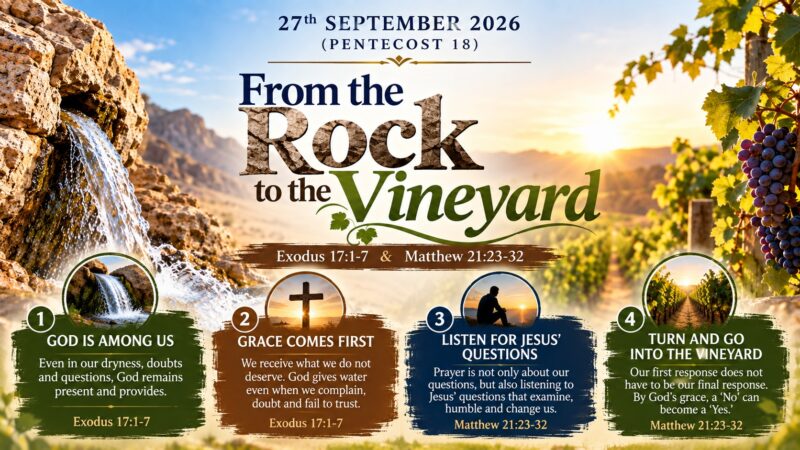
Scripture Readings: Exodus 17:1-7 & Matthew 21:23-32
(Slide 1) We live in a world full of questions. Some questions come from genuine curiosity. Some rise from pain, fear, confusion, or disappointment. Others may come from suspicion, judgement, resistance, or distrust.
People question and judge one another. They argue over who is right and who is wrong. Sometimes they question the motives of others before examining their own hearts. And sometimes, consciously or unconsciously, they ask, “God, where are You?” “Why did You allow this?” and even place God in the defendant’s chair.
At times, such questions come from a genuinely wounded heart, and God listens to our honest cries. But sometimes our questions become accusations, and disappointment turns into distrust. Then we may fail to recognise what God is already doing while we are busy questioning Him.
That tension runs through both of today’s Scripture readings. In Exodus 17, the people ask, “Is the Lord among us or not?” In Matthew 21, the religious leaders ask Jesus, “By what authority are you doing these things?” God is already among them, yet they struggle to recognise Him.
(Slide 2) In Exodus 17, the people of Israel are in the wilderness, and their thirst is real. They have no water. Their fear is understandable. They are tired, vulnerable, and frightened. Sometimes people cry because they are genuinely hurting. Sometimes we complain because we are exhausted, grieving, frightened, or overwhelmed. But the story moves beyond physical thirst. Their thirst becomes a theological question: “Is the Lord among us or not?”
This is striking because these are people who have already experienced God’s mighty deliverance. They have been freed from slavery, crossed the sea, and known God’s guidance and provision. Yet because there is no water in this particular moment, they begin to question God’s presence altogether.
Faith does not deny thirst. It does not pretend the wilderness is easy. Faith simply refuses to make our present thirst the final evidence about God. There may be moments when we cannot see the water, but that does not mean God has abandoned the wilderness.
(Slide 3) Then God says to Moses, “Strike the rock, and water will come out of it, so that the people may drink.” What is remarkable is not only that water comes from a rock, but who receives it. These are not people displaying extraordinary faith. They are quarrelling, complaining, and testing God.
And still, the water flows. The people bring complaints; God brings water. The people bring distrust; God brings provision. They ask, “Are You really among us?” and God answers not merely with words, but with water from the rock. This is grace. They receive water not because they deserve it, but because God remains faithful.
Perhaps there are times in our own lives when the “rock” before us looks hard, dry, closed, and impossible. A rock does not look like a source of water. Yet God can bring life from what appears lifeless, possibility from what seems impossible, and grace from places where we expected nothing. The rock becomes a sign that God remains present and faithful even when His people struggle to trust Him.
Our pains, pleas, and cries may differ, but may we remember together that God is listening and God is with us. He is at work even in places beyond our sight, still giving grace.
Then we come to Matthew 21. The chief priests and elders approach Jesus and ask, “By what authority are you doing these things, and who gave you this authority?” On the surface, it sounds like a reasonable question. But Jesus knows that it is not simply a sincere search for truth. It is also a challenge.
So, Jesus answers their question with a question. He asks them about John’s baptism: Was it from heaven, or from human origin? Suddenly, those who came to question Jesus find themselves questioned by Jesus. They intended to examine Him, but His question examines them.
If they say John’s authority came from heaven, Jesus can ask why they did not believe him. If they say it was merely human, they fear the crowd. So finally, they answer, “We do not know.” Jesus does not allow their question to control Him. With one question, He reveals what is happening within their hearts.
Sometimes we come to God with many questions. And we should. Prayer includes speaking, asking, crying out, and bringing our honest struggles before God. But prayer is also listening. Sometimes we bring our questions to Jesus. At other times, prayer means becoming quiet enough to hear the questions Jesus is asking us.
Through Scripture, worship, prayer, another person, circumstances, or the movement of the Holy Spirit within us, Christ may ask: “Do you trust me?”, “Why are you afraid?”, “What are you holding onto?”, “What have you seen but still refused to believe?”, “Will you follow me?”
We often want God to answer our questions. But perhaps spiritual maturity also means allowing God’s questions to reach us to examine us, humble us, change us, and lead us.
(Slide 4) Jesus continues His teaching with the parable of the two sons. A father says to one son, “Go and work in the vineyard today.” The son says, “I will not.” But later, he changes his mind and goes. The father asks the second son to go. He answers, “I will, sir.” But he does not go.
(slide 5) Then Jesus asks, “Which of the two did the will of his father?” The answer is the first. The first son says the wrong thing at first but eventually does the right thing. The second says the right thing but does not act. Jesus’ question is deeper than words: Who actually went into the vineyard?
Yet this parable is not only a challenge. It is also a word of hope. The first son initially said, “No.” But his first response was not his final response. He changed his mind, turned, and went. And that means our first response does not have to be our final response either.
(Slide 6) Perhaps we have complained, doubted, resisted, or gone in the wrong direction. Perhaps at some point we have said “No” to God. But by grace, “No” can still become “Yes.” That is repentance. Repentance is more than feeling sorry. It is turning, hearing again, responding again, and getting up and going into the vineyard.
This movement from grace to response beautifully connects our two Scripture readings. In Exodus, God acts first. The people are thirsty, complaining, and doubting, but God gives water. In Matthew, Jesus asks what our response to God’s grace will be. Grace comes before obedience, but grace calls us into obedience. When God invites and gives, we are called to turn and go.
And perhaps this is where the hymn The Servant King also speaks to us. Christ’s authority is not the authority of domination, but of humble, self-giving love. The One who asks us to enter the vineyard is Himself the Servant King who came among us to serve, to heal, and ultimately to give His life. Following Him, therefore, means more than saying we believe in Him. It means learning His way of humble service.
And so today, from the rock to the vineyard, Scripture asks us to listen. In the wilderness: “Is the Lord among us or not?” God answers with water. In Jerusalem: “Which of the two did the will of his father?”
And now that question comes to us. Perhaps we came today carrying many questions for God. But perhaps we can also become still enough to ask: “Lord Jesus, what are You asking us?”, “Where are You calling us to trust?”, “Where are You asking us to turn?”, “Where are You inviting us to go?”, “Where are You asking our spoken ‘Yes’ to become a living ‘Yes’?”
The water still flows from the rock, and grace is still given. God is still among us, and the vineyard is still before us. May we have ears to hear the questions of Jesus, hearts willing to turn, and courage to go where the Father calls. And by the grace of God, may our lives – not only our words – say: “Yes, Lord.”
Thanks be to God! Amen.
(Ref. Bible, commentaries, theological books, UCA materials, and a Vanderbilt Divinity Library Resources)Top of Form