
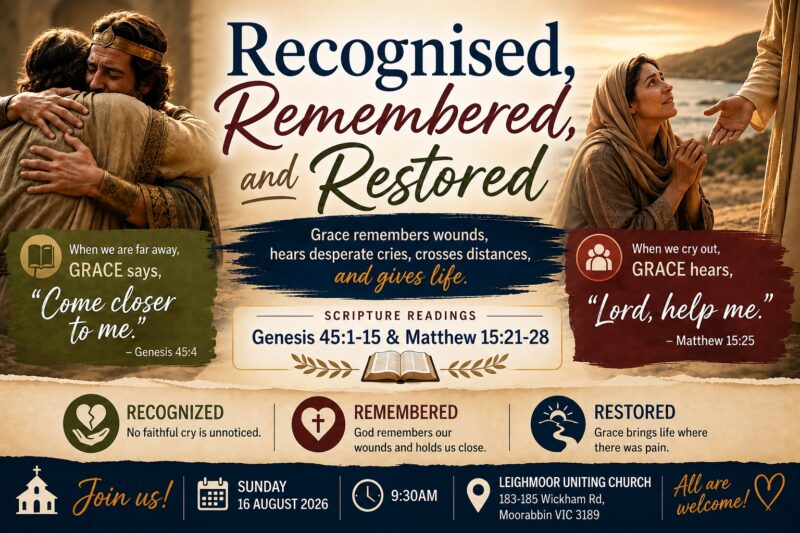
Scripture Readings: Genesis 45: 1-15 & Matthew 15: 21-28
(Slide 1) In Genesis 45:1–15, Joseph finally reveals himself to his brothers. Joseph can no longer control himself, and he begins to weep. His tears are not a sign of weakness. They are tears of deep love, remembered pain, healing, and grace. After years of betrayal, separation, suffering, and waiting, Joseph’s heart is opened before the brothers who had wounded him.
His brothers had betrayed him and sold him into slavery. Yet Joseph says, “God sent me before you to preserve life.” He has learned to see beyond human evil to the larger movement of God’s saving grace. His forgiveness does not mean denying the pain or calling evil good. He refuses to allow the worst chapter of his life to become the final interpretation of his story, believing that God was still working even there.
(Slide 2) Joseph’s brothers are terrified because they know what they have done. They might reasonably expect anger, punishment, or revenge. But Joseph says to them, “Come closer to me.” The people who caused his deepest wounds are invited to come near. When sin, shame, guilt, and fear create distance, grace says, “Come closer.”
(Slide 3) Joseph does not begin by interrogating his brothers or demanding that they defend themselves. Their recognition of their guilt had already begun earlier in the story, but here Joseph’s focus is not punishment. His focus is life, family, reconciliation, and God’s saving work.
His suffering has not been meaningless. Through Joseph’s painful journey, God prepared a way to preserve many lives, including the lives of the very family who had once rejected him. God takes wounds that could have produced only bitterness and transforms them into channels of blessing.
(Slide 4) Joseph also does more than simply say, “I forgive you.” He embraces his brothers, weeps over them, and speaks with them. Grace becomes visible. Forgiveness becomes embodied in restored relationships.
Of course, reconciliation is not always simple. Sometimes healing requires time, wisdom, honest conversation, healthy boundaries, and patient prayer. Yet Joseph shows us that forgiveness can become one of the ways God preserves life within families, churches, and communities.
So, today’s text invites us to ask: Are there places in our own lives where we are still being controlled by old wounds, old anger, or old fear? Can we trust that God is still at work, even in chapters of our story that we would never have chosen?
(Slide 5) This does not mean betrayal is acceptable or suffering is good. There is a beautiful song from “Joseph: King of Dreams”, “You Know Better Than I,” sung by Australian singer David Campbell, which says, “You know better than I, You know the way.” We may never receive an answer to every “why” in this life, but God knows our way.
(Slide 6) In Matthew 15:21-28, we meet another person who comes carrying deep pain. A Canaanite woman approaches Jesus because her daughter is suffering. Her prayer is simple and desperate: “Lord, help me.”
(Slide 7) This woman crosses many boundaries to seek mercy. She is a gentile, a woman, and an outsider to Israel’s covenant community. Yet she comes boldly to Jesus. Her faith crosses ethnic, religious, gender, and social boundaries because love for her daughter will not allow her to give up.
This is also one of the most difficult encounters in the Gospels. Jesus initially appears silent, distant, and even severe toward a woman crying out for mercy. Yet within the wider story of Scripture, Jesus’ response is not a declaration that this woman has no worth, nor is it the final boundary of God’s mercy. Instead, this encounter brings into the open the painful divisions, assumptions, and exclusions of that world – and perhaps the assumptions within the disciples themselves.
At first, Jesus does not answer her. The disciples want to send her away. Yet she continues. Silence does not stop her faith. Jesus speaks first of His mission to “the lost sheep of the house of Israel,” but this woman continues to trust that His mercy is greater than the boundary standing before her. She kneels and says simply, “Lord, help me.”
(Slide 8) She does not argue for privilege; she trusts the abundance of Jesus’ mercy. The woman does not allow rejection, silence, or social barriers to define her. Instead, she continues to come nearer. She knows who Jesus is: “Lord, Son of David.” Even though she is an outsider, she sees something that many insiders miss.
Her response about the crumbs under the table is remarkable. The woman recognises that even a crumb of Jesus’ mercy is enough and powerful. In God’s kingdom, crumbs are not leftovers of indifference; they are signs of overflowing abundance. The mercy of Christ is so great that even a crumb can carry healing power.
(Slide 9) Finally, Jesus says, “Woman, great is your faith!” This is extraordinary. The outsider becomes a model of faith for the insiders. The woman whom the disciples wanted to dismiss is publicly recognised and honoured by Jesus.
Are there people whom we consciously or unconsciously keep outside our circle of belonging? This story offers hope to anyone who has ever felt unseen, unheard, excluded, or unworthy. The Canaanite woman encourages us to keep bringing our pain, our children, our families, and our deepest needs to Jesus. Her story reminds us that the kingdom of God is wider than our assumptions and the mercy of God is greater than the boundaries human beings create.
Both stories involve people who might reasonably expect rejection. Joseph’s brothers expect judgment because of their guilt. The Canaanite woman might expect rejection because of her outsider status. Yet both encounters ultimately move toward mercy, and Grace remembers wounds, hears desperate cries, crosses painful distances, and gives life.
(Slide 10) And two readings move from distance to nearness. Joseph looks at the brothers who wounded him and says, “Come closer to me.” The Canaanite woman comes closer to Jesus, kneels before Him, and cries, “Lord, help me.” Grace closes distances created by sin, guilt, fear, shame, pain, and exclusion. Grace invites us closer.
Joseph says that God sent him ahead to preserve life. Jesus heals the woman’s daughter and restores hope to a suffering family. In both stories, mercy is life-giving.
Joseph’s forgiveness begins to restore a broken family. Jesus’ response reveals a mercy that cannot finally be contained by ethnic or religious borders. Together these passages ask us a profound question: Who belongs at the table of grace? The good news is that God’s mercy is greater than the boundaries we create.
God can heal broken relationships, redeem painful chapters, recognise faith in unexpected people, hear cries that others would rather silence, and preserve and restore life through grace.
In Christ, there is enough mercy not only for those who believe they are already seated at the table, but also for those who are still crying from the edges. The grace of God does not leave us far away. It calls the guilty, the wounded, the desperate, the forgotten, and the excluded: “Come closer.”
The Canaanite woman could continue to hope because she believed that Jesus could heal her daughter. May her persistent faith, earnest hope, and sincere love fill our hearts. May Joseph’s tears teach us that our wounds need not become our final story. May we listen more deeply to those crying from the margins, open our hearts beyond the boundaries we have, and trust that God is still bringing life out of places that once seemed lost.
And may we discover again that in the overflowing grace of Jesus Christ, no faithful cry is unnoticed, no wounded story is forgotten, and no life is beyond the healing work of God – for in Christ, we are Recognized, Remembered, and Restored.
Thanks be to God! Amen.
(Ref. Bible, commentaries, theological books, UCA materials, and a Vanderbilt Divinity Library Resources)Top of Form